Slicer Profiles
Key Concepts
Slicer profiles are the collections of print settings—layer height, infill, speed, temperature, and hundreds of other parameters—that control how your 3D models are converted into G-code. Printago syncs profiles from your Bambu Lab account or lets you import them directly from Bambu Studio and OrcaSlicer, so the same profiles you've tuned locally become available across your entire fleet. Profiles fall into three categories: machine profiles (printer-specific hardware settings), process profiles (quality and behavior settings like "0.20mm Standard"), and filament profiles (material-specific temperatures and flow rates tied to each material in your library). Because Printago slices on demand using these profiles, updating a setting once automatically affects all future prints that use it—no need to re-export G-code for every printer and material combination. This is especially valuable for farms where a single profile tweak needs to roll out across dozens of machines instantly.
To see which of these profiles a given print job ends up using, and which setting wins when a printer, a part, and a 3MF file all specify one, read How Slicing Works.
Getting Profiles into Printago
There are two ways to add slicer profiles to Printago:
Option 1: Bambu Lab Cloud Sync
Run the Bambu Lab Integration Flow to sync profiles from your Bambu Lab account. This requires Cloud Sync to be enabled in Bambu Studio or OrcaSlicer.
Option 2: Manual Import
Import profiles manually by exporting preset bundles from Bambu Studio or OrcaSlicer and uploading them directly to Printago. This works without cloud sync and gives you control over exactly which profiles to import.
Managing Your Profiles
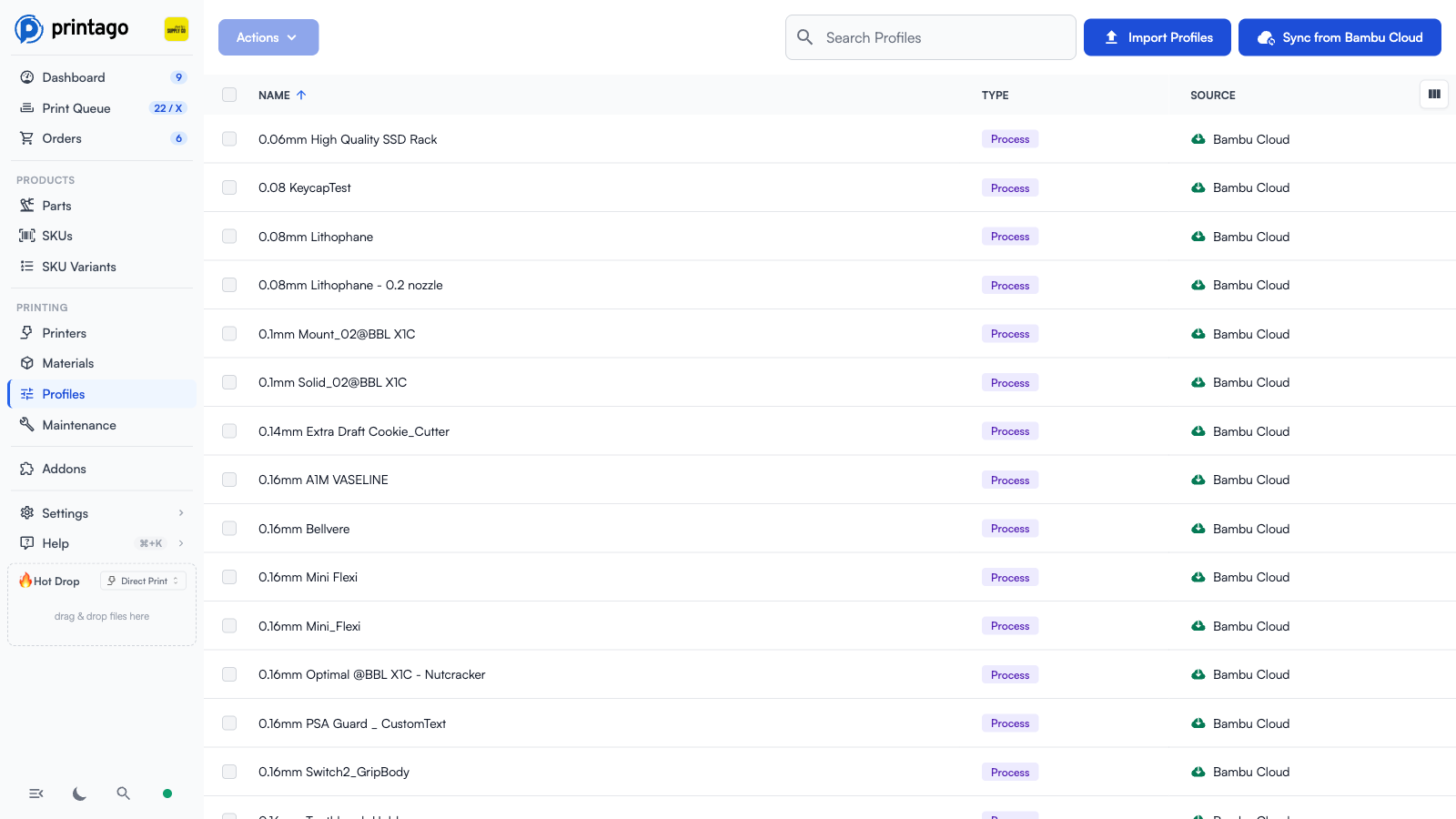
The Profiles page (Printing → Profiles) lists every profile with its Type (such as Process) and its Source (such as Bambu Cloud). The Import Profiles and Sync from Bambu Cloud buttons at the top correspond to the two import options above.
Searching Profiles
You can search through your profile list to quickly narrow down and find specific profiles.
Deleting Profiles
Profiles can be deleted directly from the Printago interface. However, note that:
- Deleting profiles from your Bambu account alone won't delete them from Printago
- You must delete them from within Printago to remove them from your list
Editing Profiles
Click on any profile to open the edit view, where you can:
- Rename the profile
- View all settings including both your custom overrides ("Own") and inherited values from the base profile ("Inherited")
- Copy settings to clipboard
- Lock the profile to prevent accidental changes
Profile Inheritance and Slicer Versions
Most profiles inherit from a base profile (e.g., 0.20mm Strength @BBL X1C). Printago maintains multiple versions of these base profiles from different slicer releases.
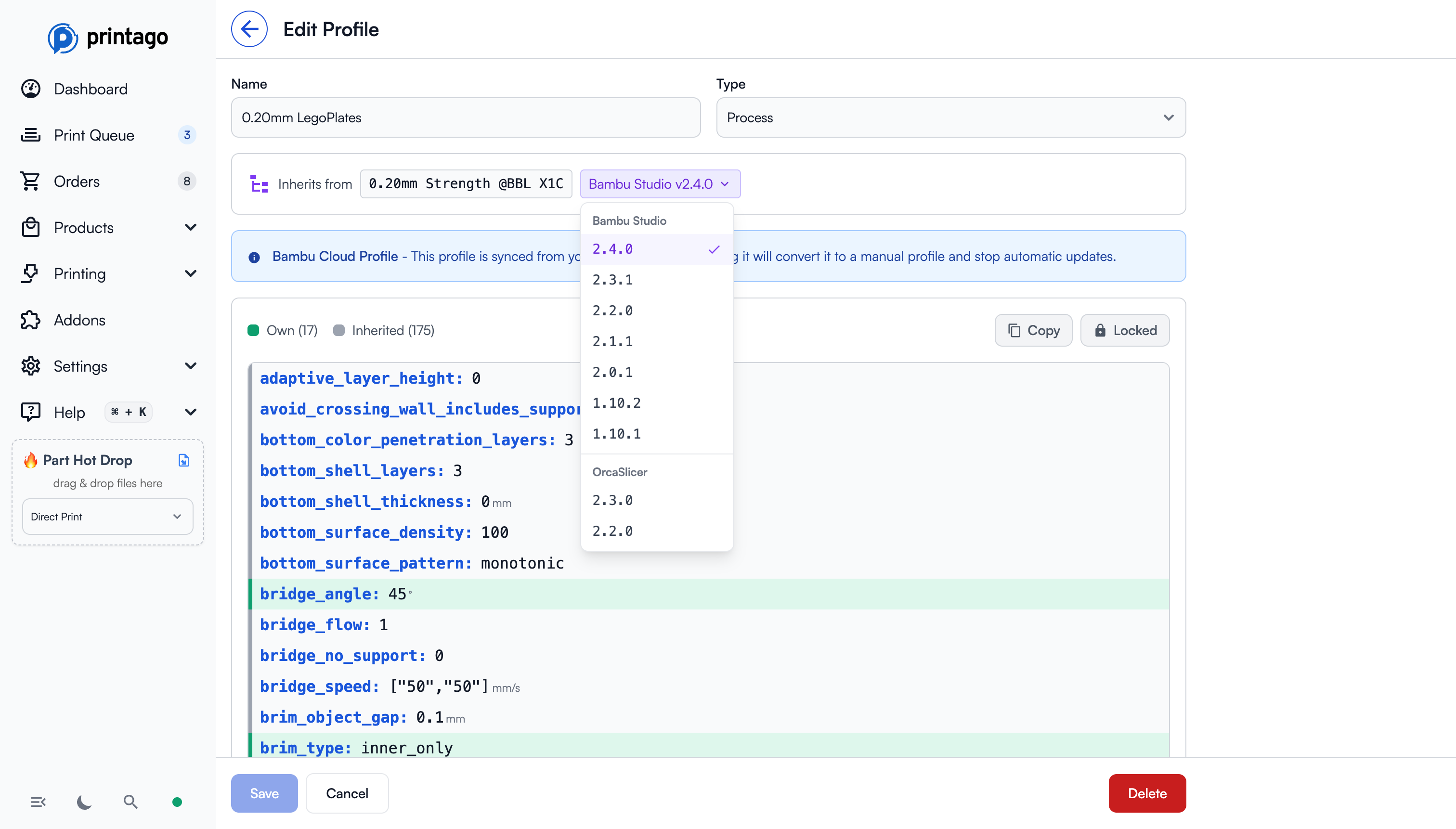
Use the slicer version dropdown to:
- Compare inherited values across different Bambu Studio and OrcaSlicer versions
- Select which slicer version the inherited values should come from when cloud slicing
This is useful when:
- A newer slicer version changed default settings you relied on
- You want to use OrcaSlicer's interpretation of a profile instead of Bambu Studio's
- You need to troubleshoot differences in slicing behavior between versions
The selected slicer version determines which base profile values are used when the Cloud Slicer generates GCODE for your prints
Base profiles that share a name across brands
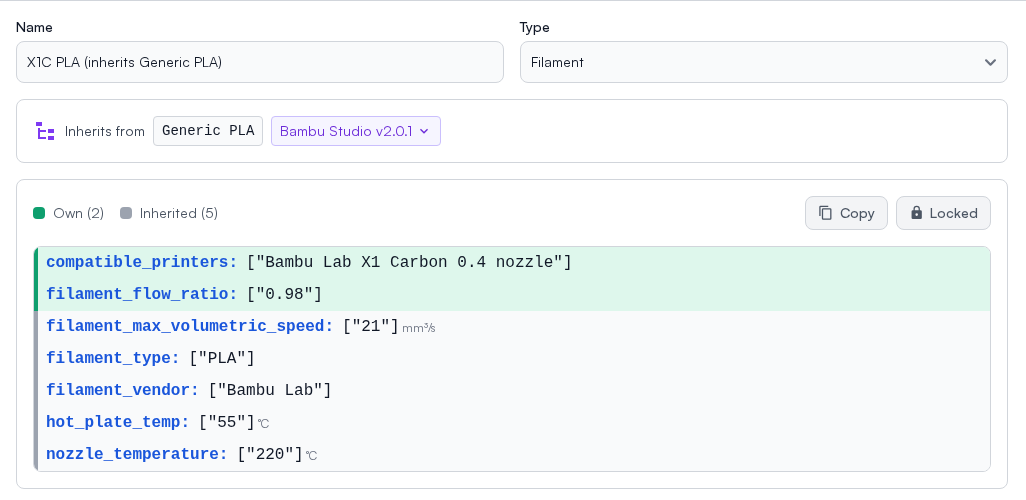
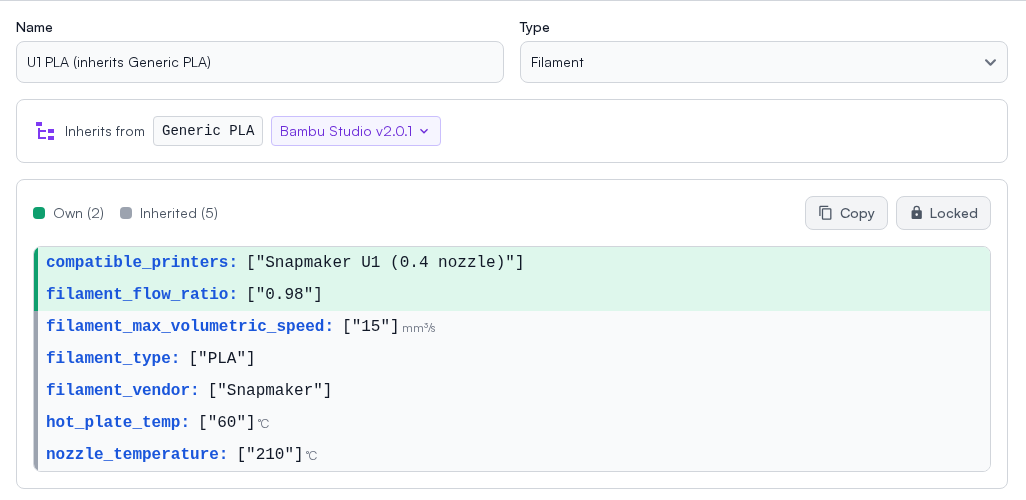
Several printer brands ship base profiles with the same name. Bambu Lab's Generic PLA and Snapmaker's Generic PLA are different profiles (different printers, different settings), and Printago keeps both in its catalog.
When your profile inherits from a name like that, Printago picks the base profile for the printers your profile is compatible with:
- A profile synced from your Bambu Lab account, or one whose compatible printers are Bambu Lab machines, inherits Bambu Lab's base profile.
- A profile imported for a Snapmaker, Elegoo, or other brand's printer inherits that brand's base profile.
- If nothing ties the profile to a brand, the stock slicer catalog is used rather than a manufacturer's own slicer build.
The version dropdown only offers slicer releases that carry the base profile for that brand, so switching versions never swaps in another brand's settings. If the brand has no build for the slicer you chose, the inherited values come from the brand's current catalog entry instead. The same rule applies to the include templates an imported profile carries and to a system profile you select directly: Printago stays within that profile's brand, and a slicer build from another brand is never substituted.
Printer Compatibility
Every filament and process profile carries a list of the printer models it can be used on. Printago uses that list whenever it offers you a profile for a specific printer: the profile dropdowns on a material's Profile Assignments, the per-slot filament profile picker on a printer, and the Cloud Slicer's profile matching all show only the profiles whose list includes that printer model and nozzle size.
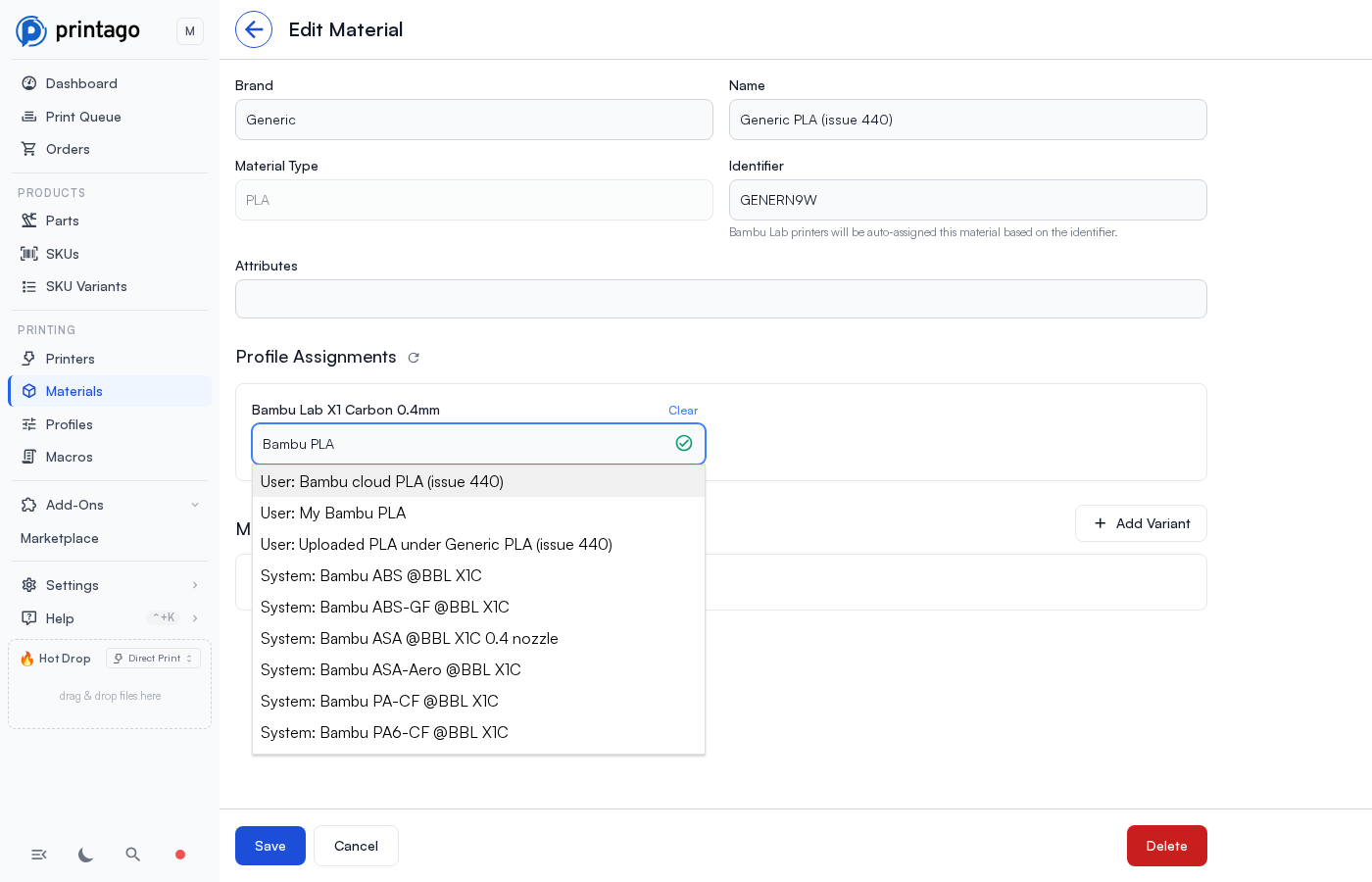
The list is filled in when a profile is imported, in this order:
- The base profile it inherits from. Most user profiles are thin overrides of a built-in profile (for example, a Bambu Lab cloud preset based on
Generic PLA). Printago looks up that base profile in the same slicer vendor's catalog the profile came from, so a Bambu Lab cloud preset always inherits Bambu's list, even when another printer manufacturer ships a profile with the same name. The base profile only counts when it actually lists printers: a base with an empty list (such as the@Systemfilament library profiles in OrcaSlicer) is ignored rather than wiping out the values below. - The profile's own
compatible_printerssetting. A manually imported profile that names its printers keeps that list. - Machine profiles identify themselves by their own printer model and nozzle size instead; they have no list of their own.
When you edit a profile, the order of the first two steps is reversed: the profile's own compatible_printers setting wins, and the base profile is consulted only when the profile does not name any printers itself. That way a list you typed in by hand is never replaced by the base profile's list on save.
When none of these yield anything, the profile has no compatible printers and will not be offered anywhere. You can fix that by editing the profile and adding a compatible_printers entry to its settings, or by changing which base profile it inherits from: saving the edit recomputes the list.
Profiles imported from a Bambu Lab account match the printer models Bambu Studio itself lists for the base profile, not just the printers currently in your store, so a printer you add later still matches without re-importing.